


 XPipe
XPipe
Weekly Highlights
This past December, I featured a new Docker management platform called Dockhand in the New Software section of this newsletter. At the time, I mentally wrote the project off for several reasons.
Not only is the market for these platforms already a bit saturated, but the project's low-res icon is a bit off-putting and its repo features an AI disclaimer that reminds me of the older trend where people thought posting 'Facebook is required to respect my privacy' actually meant Facebook was legally obligated to respect their privacy.

Needless to say, I was a bit surprised to see it pop up in several places across the community this week, most notably covered by DB Tech and Lawrence Systems over on YouTube. In general, the consensus seems to be that the platform's functionality, ease-of-use, and streamlined interface make it more attractive than many of its counterparts.
There's probably a lesson to be learned here about not judging a book by its cover, but regardless – if you've been put off by Portainer's recent rebranding or don't need Komodo's bells and whistles, you should probably check it out.
Unrelatedly (but on the topic of icons), selfh.st/icons officially hit 100 million+ monthly requests this week. The project is a labor of love that consumes more of my time than I'd care to admit, and I'm extremely grateful to all who've contributed. As usual, drop a discussion on GitHub if the collection is missing anything you might need for your project, dashboard, etc.
If you're looking for other things to dig into this weekend, check out this new comic format created by a Redditor after debating the merits of CBZ on a manga subreddit, Snikket's (XMPP) upcoming Android makeover, and Raspberry Pi's new flash drive.
Happy selfh.st/ing!
Self-Host Weekly is an independent publication supported by its readers. Consider signing up or making a donation to show your support and and receive exclusive member perks for your contribution!
Newswire
 Gareth Halfacree
 Nick Vidal


 Fred Schott
More From selfh.st
 Ethan Sholly
 Ethan Sholly
Content Spotlight
Meet Scanopy, a web-based network diagram and visualization platform. With Scanopy, users can easily generate interactive diagrams of hosts and services on their network via auto-discovery for monitoring, documentation, and sharing with others. Features include pre-defined service definitions for over 200 platforms, interactive and customizable diagrams, distributed scanning, Docker integration, multi-user support, and scheduled discovery.
Scanopy can be easily deployed via Docker and requires a separate PostgreSQL container for data storage.
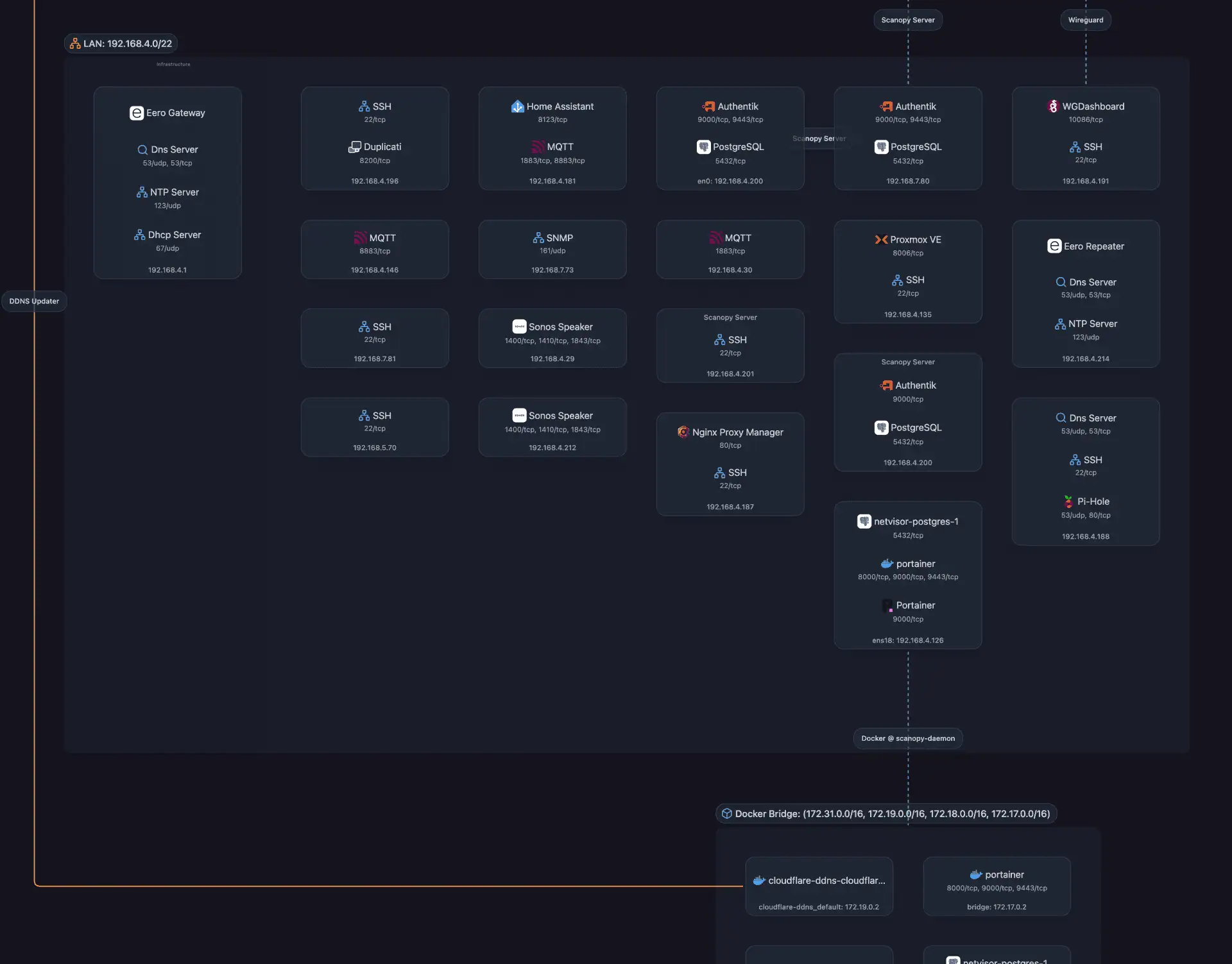
Links: Website, Source Code
Videos and Podcasts
- Dockhand Deep Dive: The NEW Docker Management Tool Explained | DB Tech
- Docker Compose Without the Headache | Docker Composemaker | Servers@Home
- Dockhand: The Easiest Way I’ve Found to Manage and Update Docker Containers | Lawrence Systems
- Palmr - Simple File Sharing that keeps your files off the big guys' cloud | Awesome Open Source
- Self-hosted Cloudflare + VPN replacement! Pangolin Tutorial | Christian Lempa
- I Installed Unraid on This Mini PC… and It Actually Worked | AlienTech42
Command Line Corner
Use diff -y file1 file2 to quickly view side-by-side differences between two files from the command line:
$ cat example.txt
  self-
  host
  weekly
$ cat example2.txt
  self
  host
  weekly
$ diff -y example.txt example2.txt
  self-      | self
  host         host
  weekly       weekly
Click here for an archive of commands shared in past newsletters.
Executive Sponsors
Thanks to following executive sponsors, whose continued support makes this newsletter possible:
Share Your Content
I'm always looking for new and existing self-hosted content to share in Self-Host Weekly. Reach out using the button below if you'd like to have your own content featured or have a suggestion for content types you'd like to see featured in future newsletters.